
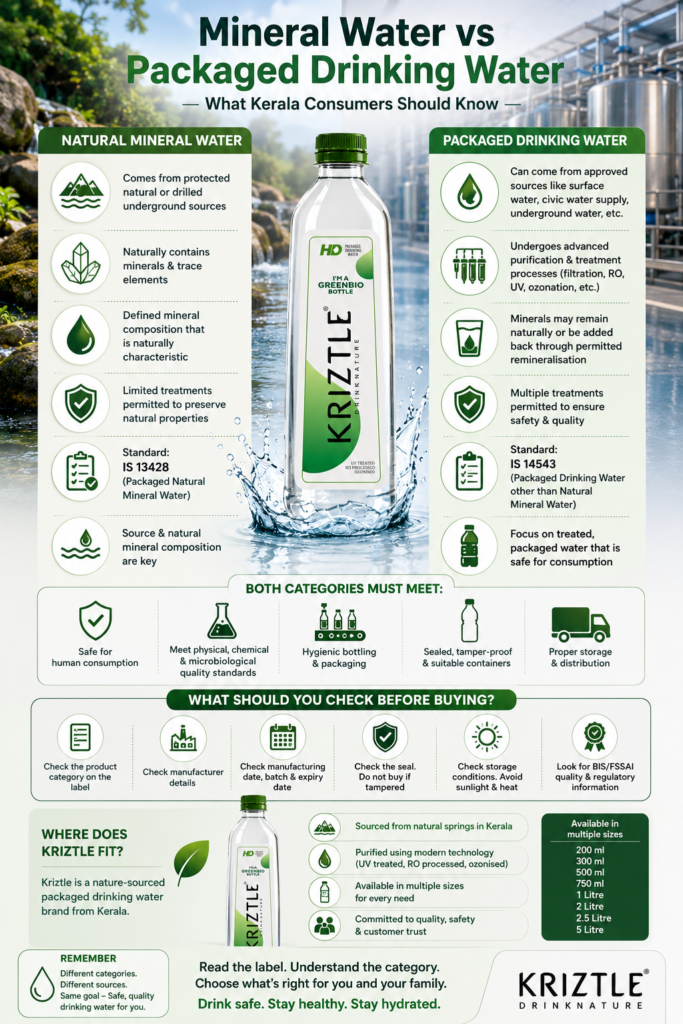
Pick up a bottle of water in Kerala and you’ll often hear it called “mineral water.” For many people, the two terms simply mean bottled water.
Technically, though, mineral water and packaged drinking water are not the same thing.
The difference comes down to where the water comes from, how it is treated, what naturally remains in it, and the standards that apply to the finished product. Once you understand this, reading a water bottle label becomes much easier.
This distinction matters in Kerala, where consumers have access to many packaged water brands and products. Whether you’re buying a bottle for a journey, stocking water at home, arranging drinks for a function, or choosing a regular supplier for your office, knowing what you’re actually purchasing helps you make a better decision.
In this guide, we’ll explain the difference between mineral water vs packaged drinking water, how Indian standards define each category, what to check on a bottle, and where Kriztle fits into the picture.
Mineral Water vs Packaged Drinking Water: The Basic Difference
Let’s start with the simplest explanation.
Natural mineral water comes from a protected underground source and has a characteristic mineral composition. Its source, composition, collection, and permitted treatment are subject to specific requirements.
Packaged drinking water, on the other hand, is water intended for human consumption that is packaged after undergoing permitted treatment. It can come from different sources and may be treated using processes such as filtration, reverse osmosis, remineralisation, and disinfection.
The Bureau of Indian Standards distinguishes these categories through separate standards. IS 13428 relates to packaged natural mineral water, while IS 14543 relates to packaged drinking water other than packaged natural mineral water.
So, the first thing to remember is simple:
Not every bottled water product is natural mineral water.
And that’s perfectly fine. Packaged drinking water is a separate category with its own quality requirements.
What Is Natural Mineral Water?
Natural mineral water has a very specific meaning under Indian standards.
BIS describes it as water obtained directly from natural or drilled underground sources. The source must be protected against pollution and external influences, and the water is characterised by its mineral salts, trace elements, composition, and other natural characteristics. It is collected in a way that preserves its original microbiological purity and essential chemical composition.
That source is a major part of what makes natural mineral water different.
The mineral profile isn’t simply created during manufacturing. It is associated with the natural source itself.
What makes natural mineral water different?
Natural mineral water generally has:
- A protected underground source
- A characteristic mineral composition
- Natural mineral salts and trace elements
- Specific source protection requirements
- Limited permitted treatment
- Controlled hygienic collection and packaging
This is why the term “natural mineral water” shouldn’t be used casually for every packaged water product.
What Is Packaged Drinking Water?
Packaged drinking water is broader.
Under Indian food safety regulations, packaged drinking water is water other than natural mineral water that is offered or sold in packaged form for human consumption. The regulations allow water from sources such as surface water, civic water supply, underground water, and other permitted sources, subject to the applicable treatment and quality requirements.
Depending on the source and production process, treatment can include:
- Filtration
- Membrane filtration
- Activated carbon filtration
- Demineralisation
- Remineralisation
- Reverse osmosis
- Disinfection
The finished water is then filled into suitable sealed containers for direct consumption.
This is why a packaged drinking water company may use sophisticated purification technology to make sure the final product meets the required quality specifications.
Mineral Water vs Packaged Drinking Water: A Quick Comparison
| Factor | Natural Mineral Water | Packaged Drinking Water |
| Source | Protected natural or drilled underground source | Approved sources including surface, civic, or underground water |
| Mineral composition | Naturally characteristic | May be adjusted through permitted treatment |
| Treatment | Limited treatments permitted | Several purification and disinfection processes may be used |
| Main standard | IS 13428 | IS 14543 |
| Packaging | Hygienic sealed packaging | Hygienic sealed packaging |
| Main focus | Natural source and mineral characteristics | Safety, treatment, quality and suitability for consumption |
The important point is that different doesn’t mean one is automatically safer than the other.
A properly produced packaged drinking water product can meet strict quality requirements. Natural mineral water has a different definition and production framework.
Why Do Companies Purify Packaged Drinking Water?
A common question is: if water comes from a good source, why treat it at all?
Because source quality is only one part of the equation.
Water intended for packaged consumption needs to meet quality requirements consistently. A controlled purification process can help manufacturers manage physical, chemical, and microbiological parameters before the water reaches the consumer.
Treatment can be designed around the characteristics of the source water.
For example, depending on the source and production system, manufacturers may use filtration, membrane processes, reverse osmosis, disinfection, or remineralisation. FSSAI’s packaged drinking water requirements specifically recognise several of these treatment methods.
The goal isn’t simply to make water “look clean.”
The goal is to produce a consistent finished product that is suitable for drinking.
Does Mineral Water Have More Minerals?
This is where marketing claims can sometimes create confusion.
Natural mineral water is characterised by minerals and trace elements that occur naturally in its protected source. Packaged drinking water can also contain minerals, either because some remain naturally after treatment or because remineralisation is part of the permitted production process.
So the statement “packaged drinking water has no minerals” isn’t accurate.
Likewise, saying “all mineral water is healthier because it has more minerals” oversimplifies the issue.
For everyday hydration, the primary requirement is safe drinking water. Mineral content is only one part of the overall picture.
What Does “With Minerals” Mean on a Water Bottle?
You may have noticed bottles labelled with phrases such as “with minerals.”
That wording doesn’t automatically mean the product is natural mineral water.
The product category and regulatory classification matter.
For example, Kriztle’s current product range includes packaged drinking water products, and its Water 18 bottle is described on the product packaging as “Packaged Drinking Water With Minerals.” Kriztle also describes its water as nature-sourced packaged drinking water and says it combines sourcing and purification with modern technology.
This is a useful example of why consumers should read the complete label rather than relying on the generic phrase “mineral water.”
What Makes Packaged Drinking Water Safe?
Safety doesn’t come from one feature.
It depends on several stages working together.
Source Management
The source needs to be suitable for the intended production process and protected from contamination.
Water Treatment
The manufacturer needs to use appropriate purification and disinfection processes based on the source and product requirements.
Laboratory Testing
Water quality needs to be monitored against applicable physical, chemical, and microbiological parameters.
Hygienic Bottling
The purified water must be packaged in suitable containers under hygienic conditions.
Proper Storage and Distribution
Even properly produced water needs to be handled and stored correctly after leaving the production facility.
FSSAI’s packaging requirements specify that packaged drinking water and mineral water should be packed in clean, hygienic, colourless, transparent, tamperproof containers suitable for preventing contamination or adulteration.
How Should Kerala Consumers Read a Water Bottle Label?
You don’t need to be a water-quality expert to make a sensible purchase.
Start with the basics.
1. Check the product category
Look at whether the bottle identifies itself as packaged drinking water or natural mineral water.
Don’t rely only on what a shopkeeper or advertisement calls it.
2. Check the manufacturer
The manufacturer’s name and relevant details should be clearly available.
3. Check the batch and date information
Look for manufacturing or packaging information and the applicable expiry or use-by details.
4. Check the seal
A damaged or tampered seal is a reason to choose another bottle.
5. Check the storage condition
Avoid products that appear to have been stored carelessly, particularly in direct sunlight or excessive heat.
6. Look at the applicable certification and regulatory information
Standards and certification requirements can change, so consumers should rely on current information from BIS and FSSAI rather than outdated assumptions.
Is Packaged Drinking Water Safe for Everyday Use?
When produced and handled according to applicable standards, packaged drinking water is intended for direct human consumption.
But “packaged” does not mean you can ignore basic handling.
Once you open a bottle, the way you store and use it matters. Keep opened containers clean and follow the manufacturer’s storage directions.
For larger containers used at homes or offices, hygienic handling becomes even more important because the container may be opened and used repeatedly.
Mineral Water vs Packaged Drinking Water in Kerala
Kerala has a particularly interesting bottled-water market.
The state has abundant natural water resources, a strong hospitality sector, a large tourism industry, and a high demand for packaged water across homes, offices, restaurants, events, and travel.
That means consumers encounter both nationally recognised brands and Kerala-focused water companies.
For someone looking for packaged drinking water in Kerala, the question shouldn’t simply be “Which brand calls itself mineral water?”
A better set of questions is:
- What category is the product?
- Where does the water come from?
- How is it treated?
- What quality controls are followed?
- Is the packaging properly sealed?
- Is the product stored correctly?
- Does the brand clearly communicate what it sells?
Those questions lead to a much more meaningful comparison.
Where Does Kriztle Fit?
Kriztle positions itself as a nature-sourced packaged drinking water brand connected with Kerala.
According to Kriztle’s product information, its water is sourced from springs in Kerala and the company combines nature-focused sourcing with modern purification and production technology. Its current product portfolio includes several product lines and bottle sizes, from smaller individual bottles to larger 2.5 litre and 5 litre formats.
That positioning is worth understanding correctly.
Kriztle’s products should not automatically be described as natural mineral water simply because the brand talks about natural sources or minerals. The exact product category and label are what matter.
For consumers, this transparency is useful. You can appreciate the connection with Kerala’s natural water sources while also understanding that the product is packaged drinking water.
Why the Difference Matters
At first glance, this might seem like a technical distinction that only manufacturers need to understand.
But it actually helps consumers.
Imagine buying two bottles.
One is labelled natural mineral water.
The other is labelled packaged drinking water with minerals.
They may look similar on a supermarket shelf. They may even taste similar.
But they belong to different product categories, and the standards governing their source and processing are different.
Once you understand that, product labels become much easier to interpret.
You don’t have to assume that one is automatically better.
You can simply ask whether the product category, quality standards, source, processing, packaging, and brand practices match what you’re looking for.
Common Misconceptions About Bottled Water
“All bottled water is mineral water.”
No. Packaged drinking water and natural mineral water are separate categories.
“Packaged drinking water has no minerals.”
Not necessarily. Minerals can naturally remain in the water or be part of permitted remineralisation processes.
“Natural mineral water doesn’t need quality control.”
It does. Natural mineral water has specific requirements for source protection, composition, microbiological purity, collection, and packaging.
“A premium-looking bottle means better water.”
Packaging design says very little about actual water quality.
Look at the product information and the standards behind it.
“More minerals automatically means healthier water.”
Not necessarily. Mineral content is only one aspect of drinking water quality.
Which One Should You Choose?
There is no universal answer.
If you specifically want water that meets the definition of natural mineral water and value its naturally characteristic mineral composition, look for products clearly classified and labelled as natural mineral water.
If you want a reliable packaged drinking water product that has undergone controlled purification and is designed for convenient everyday consumption, packaged drinking water can be an appropriate choice.
For many Kerala consumers, the decision may ultimately come down to availability, taste, packaging, trust in the manufacturer, and the particular use case.
The key is knowing what you’re buying.
What Should You Look for in a Packaged Drinking Water Brand?
Before choosing a regular brand, consider these factors:
- Clear product classification
- Appropriate quality standards
- Controlled purification
- Hygienic bottling
- Proper packaging
- Transparent product information
- Consistent availability
- Suitable bottle sizes
- Reliable distribution
- Good storage and handling
A brand doesn’t become trustworthy simply because it has been around for a long time. Consistency across these areas matters more.
Why Kriztle Is Worth Considering
Kriztle brings together two ideas that work well for Kerala consumers: a connection to the state’s natural environment and a modern approach to packaged water production.
The brand says it sources water from springs in Kerala and uses modern technology across sourcing, purification, and delivery. Its product range also includes several bottle sizes and formats intended for different occasions.
That makes Kriztle relevant for consumers who are looking for a packaged drinking water company in Kerala rather than simply searching for a familiar national brand.
And perhaps the biggest takeaway is this: you don’t need to call every bottled water product “mineral water” to appreciate its quality.
The product should be judged by what it actually is, how it is produced, and whether it meets the standards that apply to it.
Frequently Asked Questions
What is the difference between mineral water and packaged drinking water?
Natural mineral water comes from a protected underground source and has a characteristic natural mineral composition. Packaged drinking water is water other than natural mineral water that can come from permitted sources and undergo approved treatment processes before being packaged.
Is packaged drinking water the same as mineral water?
No. They are separate categories under Indian standards. IS 13428 covers packaged natural mineral water, while IS 14543 covers packaged drinking water other than packaged natural mineral water.
Does packaged drinking water contain minerals?
It can. Minerals may remain naturally in the water or be introduced through permitted remineralisation processes, depending on the product and treatment method.
Is natural mineral water healthier than packaged drinking water?
Not automatically. Both are different categories with different requirements. Safe drinking water quality depends on factors such as source, treatment, microbiological and chemical quality, packaging, and handling.
What is IS 14543?
IS 14543 is the Indian Standard for packaged drinking water other than packaged natural mineral water. BIS materials distinguish it from IS 13428, which covers packaged natural mineral water.
What should consumers check before buying packaged drinking water in Kerala?
Check the product category, manufacturer information, batch and date details, seal condition, storage condition, and applicable certification or regulatory information. Buying from a reliable source also helps.
Is Kriztle natural mineral water?
Kriztle currently describes its products as nature-sourced packaged drinking water. Its product range includes products labelled “Packaged Drinking Water With Minerals.” Consumers should use the exact product classification on the bottle rather than assuming that all Kriztle products are natural mineral water.
Final Thoughts
The next time someone says, “It’s all just mineral water,” you’ll know there is a little more to the story.
Natural mineral water and packaged drinking water may sit next to each other on the same supermarket shelf, but they are not interchangeable terms. Their sources, treatment options, mineral characteristics, and applicable standards can be different.
For Kerala consumers, understanding this difference is useful because it helps you make decisions based on facts rather than marketing language.
Whether you choose natural mineral water or packaged drinking water, look beyond the front of the bottle. Check the product category, understand the source and treatment, look at the label, and consider how the water has been packaged and stored.
For those looking for packaged drinking water in Kerala, Kriztle offers a nature-sourced approach combined with modern purification and a range of bottle sizes for different occasions.
The better choice isn’t simply the bottle with the biggest name. It’s the product you understand, trust, and choose for the right reason.