
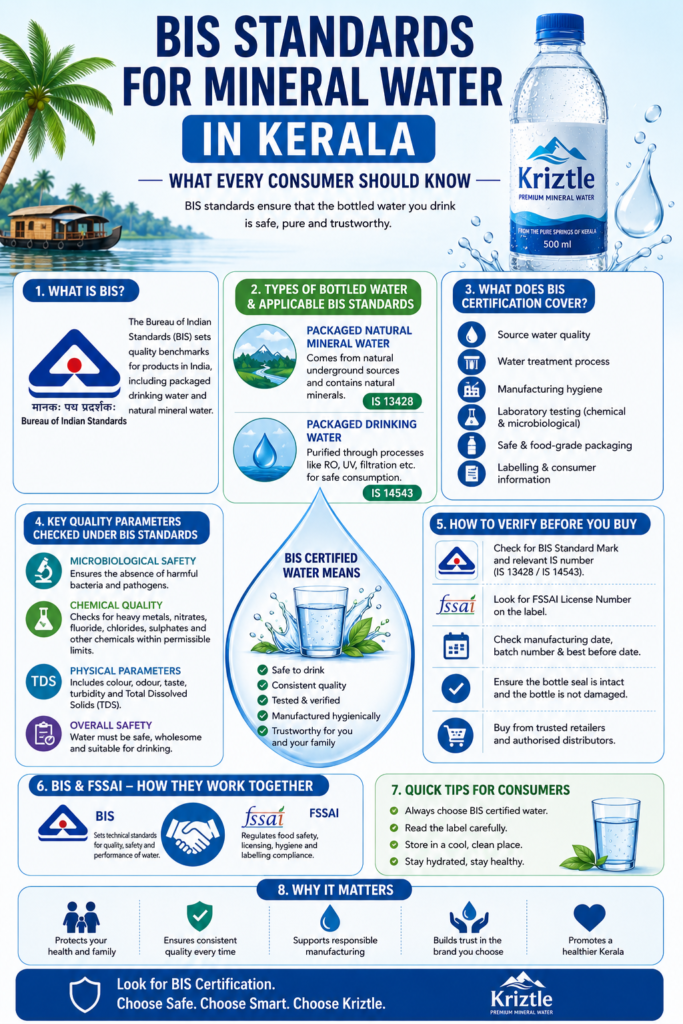
Once we enter a superstore or even a grocery store in Kerala, we would notice shelves which have bottles of water stocked up in them. Bottles are mostly similar and are always talking about purity, freshness, and mineral content, and thus making it impossible for us to distinguish from one bottle from another.
The only choice left for the customer to decide the quality of water is that it should comply with the standards fixed by the Bureau of Indian Standards (BIS).
It is very simple the purpose behind these standards – to make sure that the bottled water sold in India is fit for consumption.
Whether you are purchasing the water for your own use, for your office, or for an occasion, it is necessary that you have the knowledge of BIS standards. This article will focus on the information about BIS standards and will provide information that you should know while buying bottled mineral water in Kerala.
What Is BIS?
Indian Bureau of Standards (BIS) is the body that looks after standardization in India. The Indian Bureau of Standards has defined quality standards for numerous products including bottled drinking water and natural mineral water.
If an entity is BIS-compliant, this means that certain standards concerning production, testing, hygienic conditions, packing, and quality of the product have been fulfilled by the manufacturer.
It should be noted that BIS compliance is not only an official logo affixed to the bottle. There are specific technical requirements and inspections.
Why BIS Standards Matter for Consumers
Water is something we consume every day, often without thinking twice about it. That makes its quality especially important.
BIS standards help ensure that bottled water:
- Meets defined safety requirements
- Is free from harmful microorganisms
- Contains acceptable chemical parameters
- Is processed in hygienic conditions
- Is packaged safely for consumers
Without common standards, it would be difficult for consumers to compare products or trust the quality claims made by different brands.
Mineral Water and Packaged Drinking Water Are Not the Same
One of the most common misconceptions is that all bottled water is mineral water.
In reality, Indian regulations distinguish between two different categories.
Packaged Natural Mineral Water
The Packaged Drinking Water may come from any of the several approved sources of water and may be processed using reverse osmosis, filtration, UV treatment, or ozonation.
This falls under IS 14543.
Packaged Drinking Water
The Packaged Drinking Water may come from any of the several approved sources of water and may be processed using reverse osmosis, filtration, UV treatment, or ozonation.
This falls under IS 14543.
Both categories can be safe when produced according to BIS standards, but they follow different regulatory requirements.
What Does BIS Certification Cover?
Many people assume certification focuses only on the water itself. In practice, BIS standards cover much more than that.
They evaluate several aspects of production, including:
Source Water Quality
Manufacturers must ensure that the source water is suitable for processing and complies with prescribed quality requirements.
Water Treatment Process
The purification process must consistently produce water that meets the applicable standards.
Manufacturing Hygiene
The bottling facility must maintain high levels of cleanliness to minimise contamination risks.
Laboratory Testing
Water samples undergo regular physical, chemical, and microbiological testing to verify compliance.
Packaging Standards
Bottles, caps, and packaging materials should be suitable for food-grade use and protect the water during storage and transportation.
Key Quality Parameters Under BIS Standards
Although laboratory testing involves dozens of technical measurements, several parameters are especially important.
Microbiological Safety
The water should be free from harmful bacteria and disease-causing microorganisms.
Routine microbiological testing helps ensure the product remains safe throughout production.
Chemical Quality
Laboratories analyse various chemical characteristics to verify they remain within acceptable limits.
Examples include:
- Nitrates
- Fluoride
- Heavy metals
- Chlorides
- Sulphates
Maintaining these parameters within prescribed limits helps protect consumer health.
Physical Characteristics
Quality testing also examines:
- Colour
- Odour
- Taste
- Turbidity
- Total Dissolved Solids (TDS)
These characteristics influence both safety and the overall drinking experience.
Understanding the Role of TDS
Many bottled water labels mention TDS, but not everyone understands what it represents.
TDS stands for Total Dissolved Solids, which refers to naturally occurring dissolved minerals and salts present in water.
A moderate TDS level often contributes to a pleasant taste, while excessively high or low levels may affect flavour or indicate changes in water quality.
It’s important to remember that TDS alone does not determine whether water is safe. Safety depends on the complete set of quality parameters established by BIS.
How Manufacturers Maintain Compliance
Achieving BIS certification is not a one-time exercise.
Responsible manufacturers maintain quality through continuous monitoring, including:
- Scheduled laboratory testing
- Equipment maintenance
- Process validation
- Hygiene inspections
- Employee training
- Record keeping
- Internal quality audits
These practices help ensure that every production batch meets the required standards before reaching consumers.
Common Misconceptions About BIS Certification
“Every bottled water brand automatically has BIS certification.”
No.
Manufacturers must obtain the appropriate certification before selling products under the relevant BIS standard.
“If water looks clear, it must be safe.”
Clear water isn’t always safe.
Many contaminants cannot be detected by appearance, smell, or taste. Laboratory testing is essential.
“Mineral water never requires testing.”
Natural mineral water still undergoes rigorous testing to verify that it continues to meet regulatory requirements.
“BIS certification guarantees taste.”
Taste is influenced by natural mineral composition and consumer preference.
BIS certification focuses on quality, safety, and compliance rather than individual taste preferences.
How Consumers Can Verify BIS-Certified Bottled Water
Even if a bottle looks premium, it’s worth taking a few seconds to inspect the label before adding it to your shopping cart. A reliable mineral water brand is transparent about its certifications and manufacturing details.
Here’s what you should look for:
1. Check for the BIS Certification Mark
The bottle should display the BIS Standard Mark (often called the ISI mark) along with the applicable Indian Standard number.
- IS 13428 for Packaged Natural Mineral Water
- IS 14543 for Packaged Drinking Water
The presence of the correct standard indicates that the product falls under the relevant BIS regulations.
2. Look for the FSSAI Licence Number
Every packaged food and beverage product sold in India, including bottled water, must carry a valid FSSAI licence number. This confirms that the manufacturer complies with food safety regulations.
3. Read the Manufacturing Details
A genuine product should clearly mention:
- Manufacturing date
- Best-before date
- Batch number
- Manufacturer’s address
- Net quantity
These details improve traceability if a quality issue ever arises.
4. Inspect the Bottle
Avoid purchasing bottles that:
- Have broken seals
- Show signs of leakage
- Appear swollen or damaged
- Have faded or tampered labels
Proper packaging is an important part of maintaining water quality.
BIS and FSSAI: Understanding the Difference
People usually believe that both BIS and FSSAI have the same function, although they actually deal with different issues connected with bottled water.
Bureau of Indian Standards (BIS)
The bureau develops technical standards for bottled drinking water and natural mineral water. It establishes quality criteria, testing procedures, manufacturing procedures, and characteristics of the product.
Food Safety and Standards Authority of India (FSSAI)
This organization is responsible for food safety all over India. It deals with licensing, food safety, and labelling of food products.
For bottled water manufacturers, both of these institutions are significant. The first one guarantees the high technical quality of the product, while the second one makes sure it is safe from the food point of view.
Why BIS Standards Matter for Mineral Water Companies in Kerala
The state of Kerala has made itself known for being a producer of bottled water of high standards owing to the availability of natural water resources as well as quality manufacturing processes.
In the case of businesses that run in this particular industry, adherence to BIS standards goes beyond mere compliance.
Manufacturers that follow BIS standards generally invest in:
- Modern purification systems
- Regular laboratory testing
- Hygienic production facilities
- Skilled quality control teams
- Continuous process monitoring
These investments aid in creating consumer confidence from people who use bottled water daily for their consumption.
Expert Tips for Buying Bottled Water
If you are confused about selecting the right kind of bottled water, here are some tips for you.
- Always make sure to look for BIS certification.
- Make sure that it comes with an FSSAI licence number.
- Buy from reputed dealers/distributors.
- Look at the seal before opening the bottle.
- Try not to use bottles that have been exposed to excessive heat/sunlight.
- Ensure that the date of manufacture/‘best before’ date is within the time limit.
These steps will only take a few minutes and will help ensure you purchase safe drinking water.
Frequently Asked Questions
What does the BIS certification of bottled water mean?
The BIS certification is the certificate provided on the bottles to indicate that they have undergone production as per the quality standards prescribed by the Bureau of Indian Standards.
Is it compulsory for bottled water in India to have BIS certification?
Yes, bottled drinking water and natural mineral water packed in India are mandated to adhere to BIS standards and get certified prior to its marketing.
What is the difference between IS 13428 and IS 14543?
The former relates to packaged natural mineral water whereas the latter pertains to packaged drinking water. Both standards have different specifications according to the nature of water.
Will BIS certificate mean drinking water is absolutely safe?
BIS certificate means the manufacturer has followed the required standard and testing procedure. Along with good manufacturing practice and regulation, it will ensure that the drinking water is absolutely safe.
How do I check if the bottled water company is a BIS certified company?
Check for the BIS Standard Mark logo and the relevant Indian Standard on the water bottle. The other information that should be present on the label includes the details of the company and FSSAI Licence number.
Conclusion
Most customers do not have a laboratory at their disposal and do not have to resort to such means in order to be assured of what they are drinking. This is precisely the reason why the BIS standards are there. These give a yardstick to which manufacturers have to conform.
Although certification is a significant measure, it would be wise for consumers to learn how to read labels and purchase water from reputable brands. This is something that can make a lot of difference as far as making sure you get your hands on good water.
When it comes to mineral water companies, conforming to BIS standards does not only mean regulatory compliance. This means establishing trust through consistency and quality. Companies that follow such standards are the ones who keep their consumers’ safety at the heart of what they do.